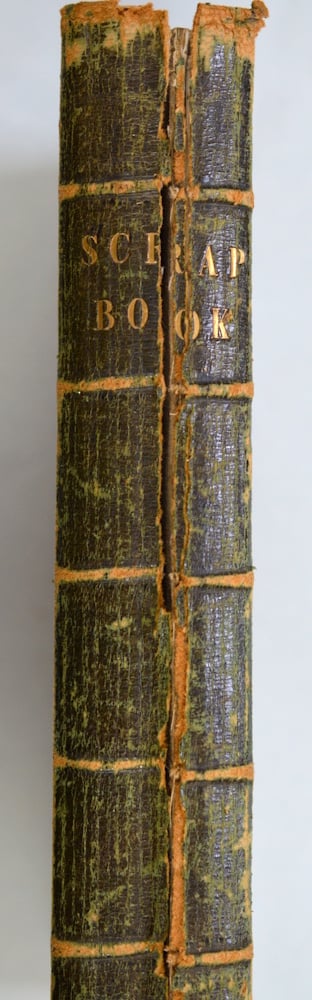
Description
Contents
Pages:
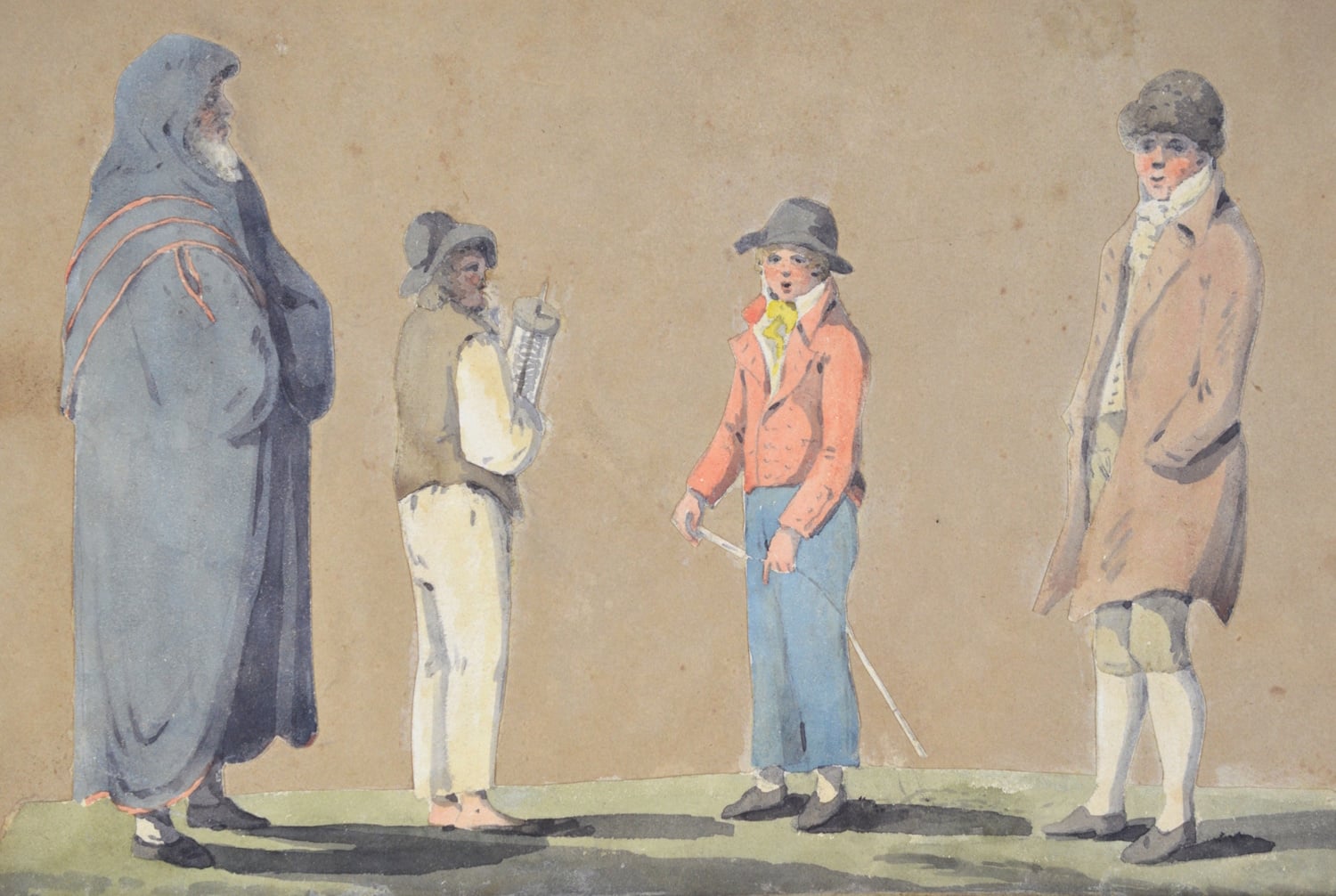
1. Study of Four Figures
Four cut-paper figures applied to the first album page. Watercolour attributed to George Heriot.
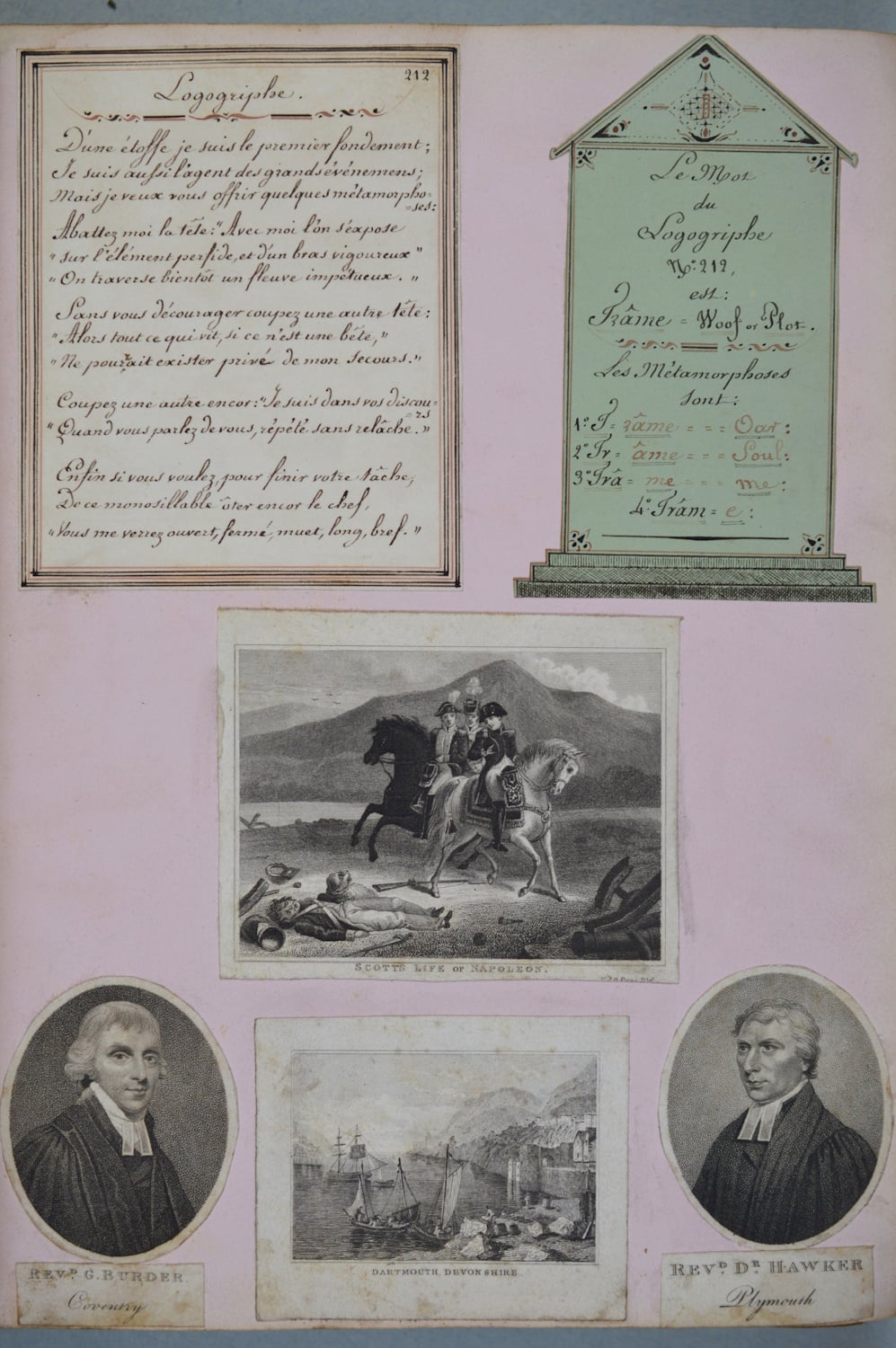
2. Logogriphes and Prints
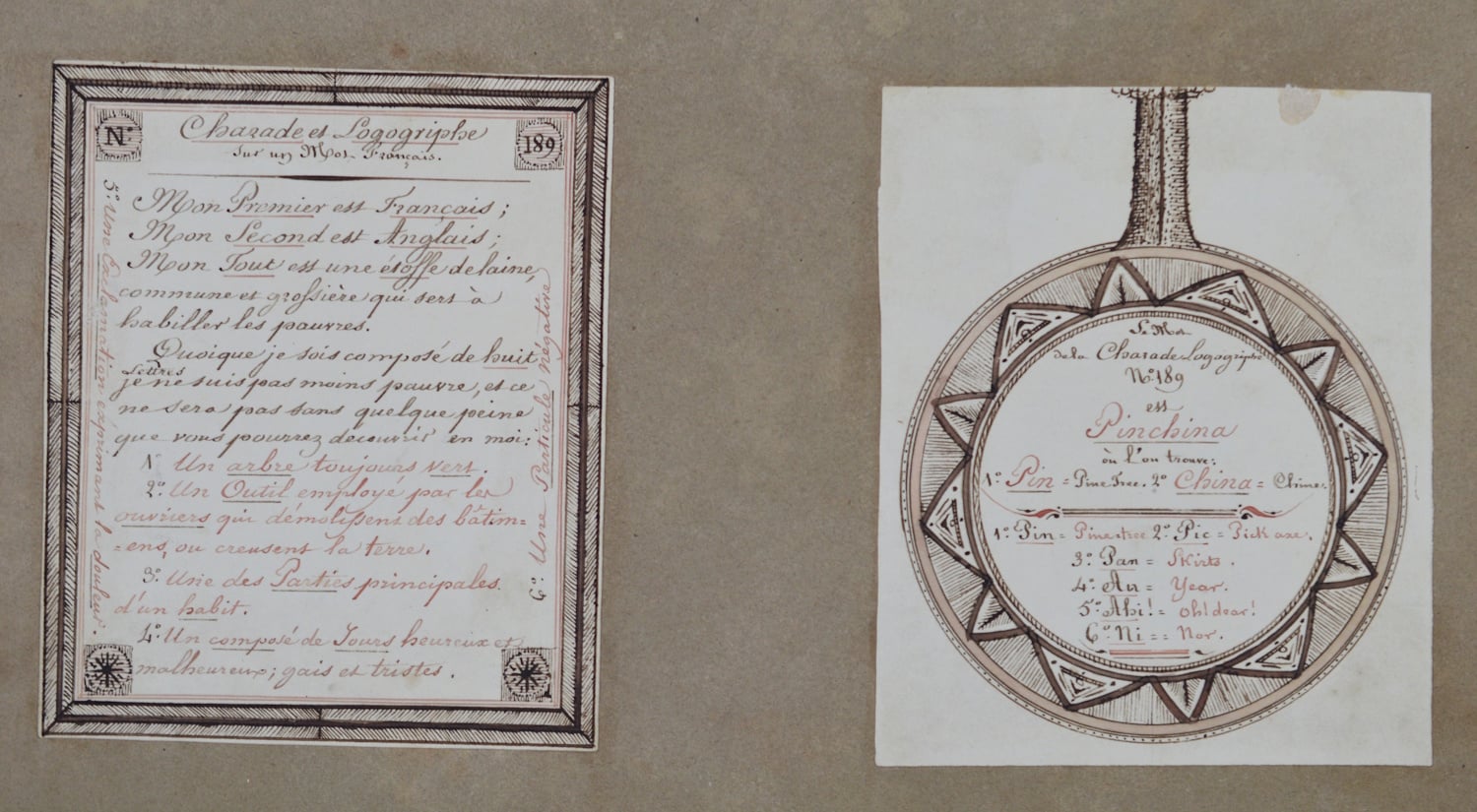
Two finely decorated handwritten Logogriphes — French word puzzles — with four small prints, including Scott’s Life of Napoleon.
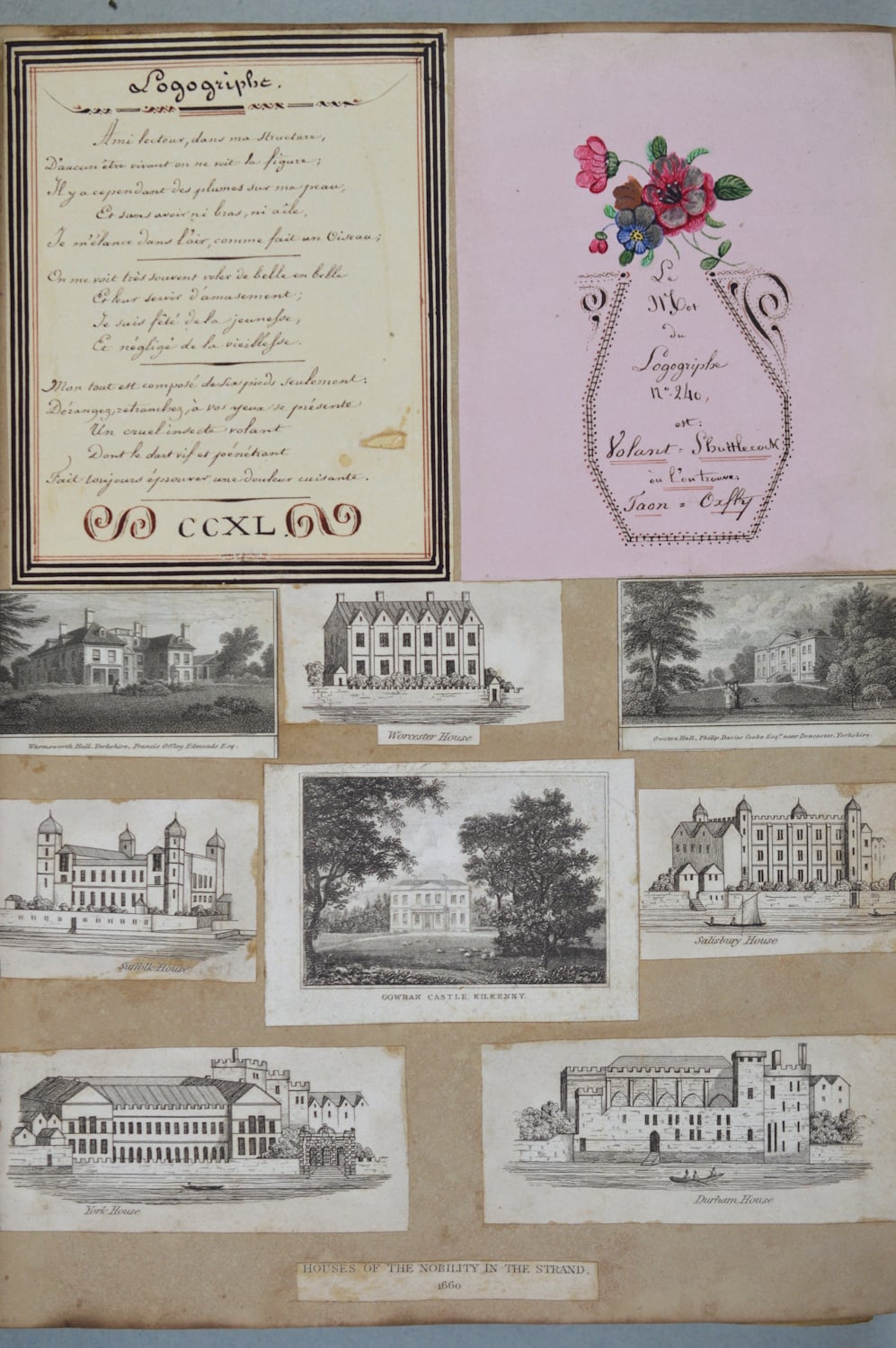
3. Logogriphes and Houses of the Nobility
Two finely decorated handwritten Logogriphes with eight small prints titled Houses of the Nobility.
4. Blank Page
Watermarked GREEN 1819.
5. Pink Moss Rose
Watercolour, possibly after John Edwards’s A Collection of Flowers, with plates dated 1783–95.
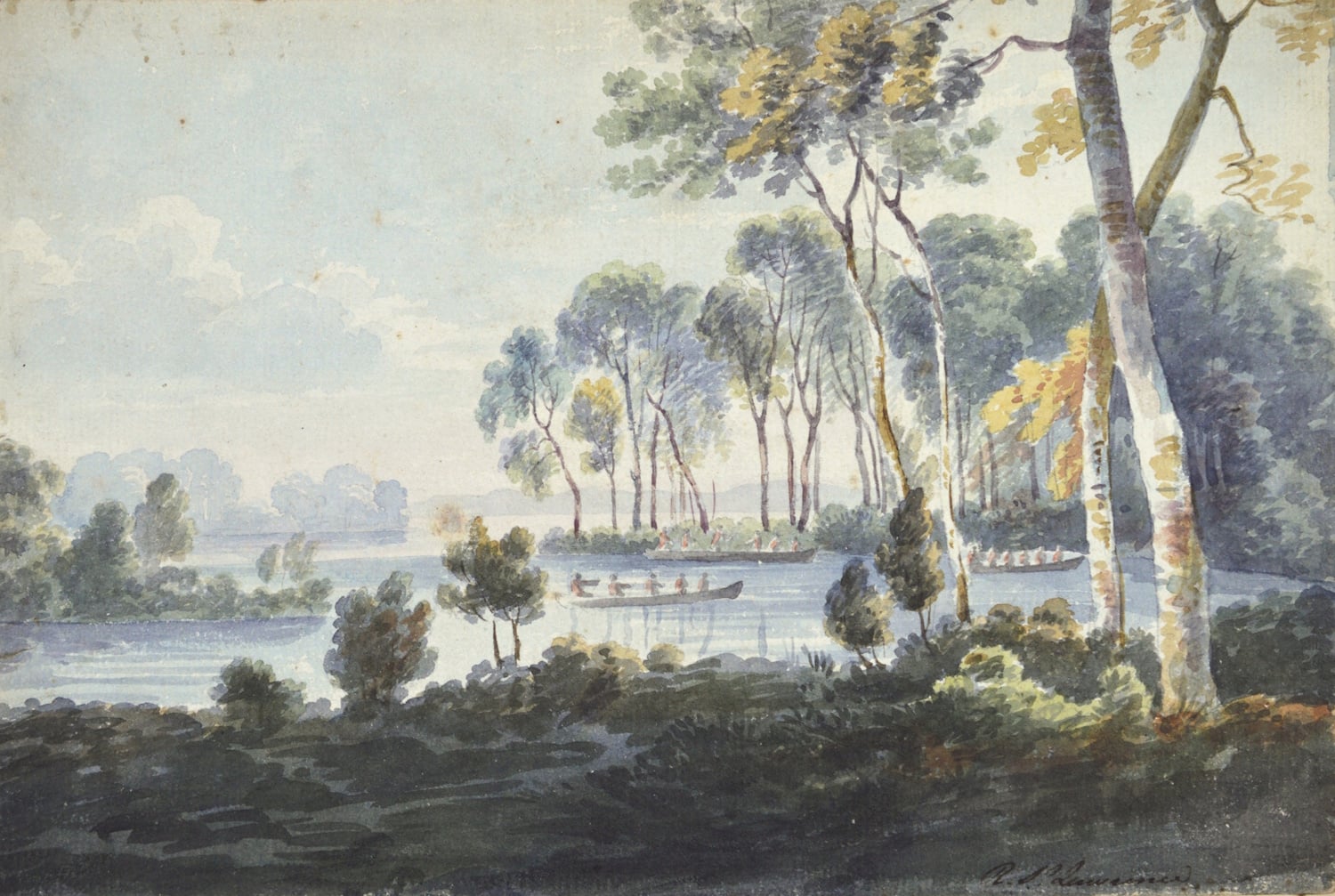
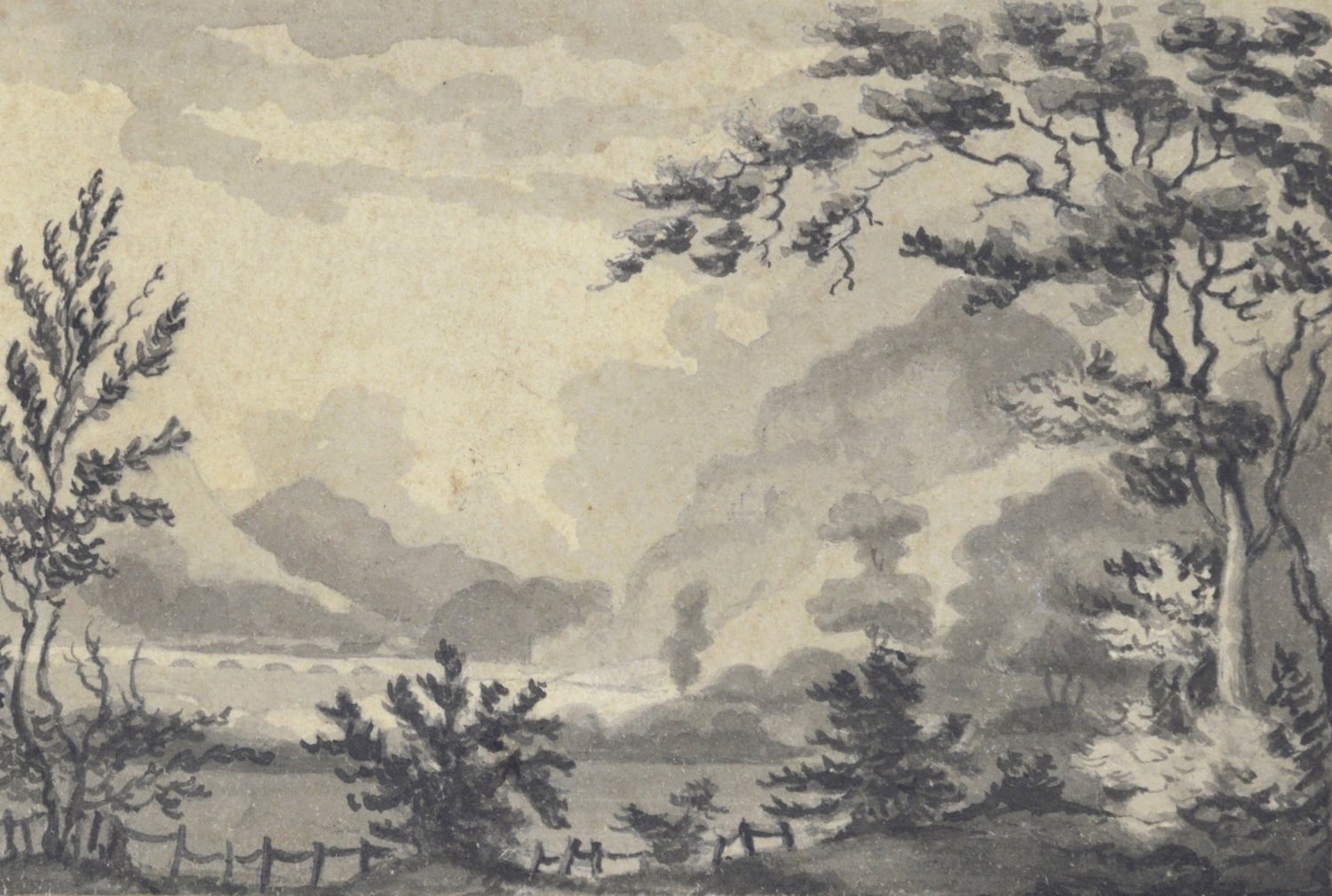
6. Lake Scene
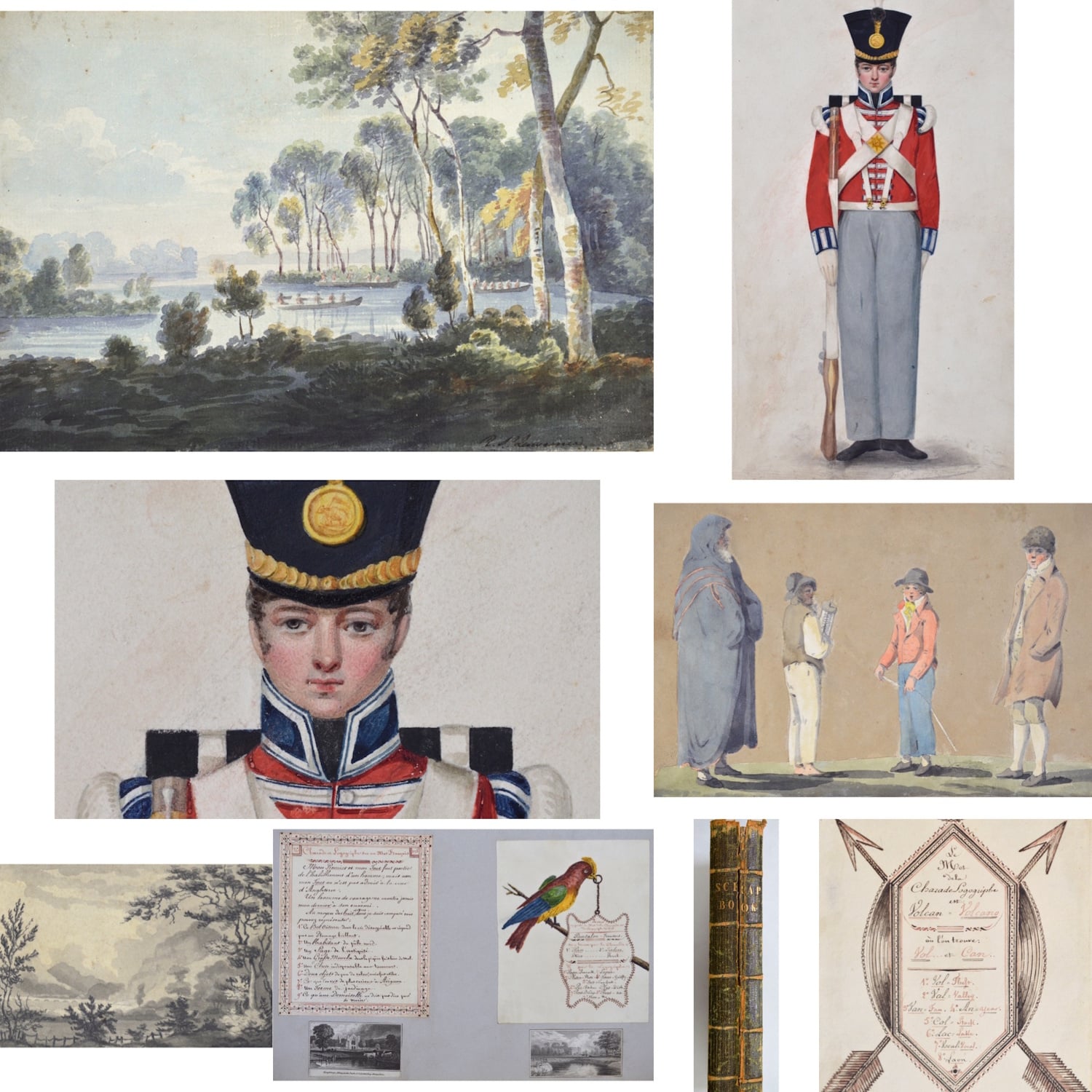
Lake scene attributed to George Heriot. Monochrome wash with point of brush and framing lines. 7.4 x 11.1 cm.
7. Logogriphes
Two finely decorated handwritten Logogriphes.
8. Blank Page
Blank.
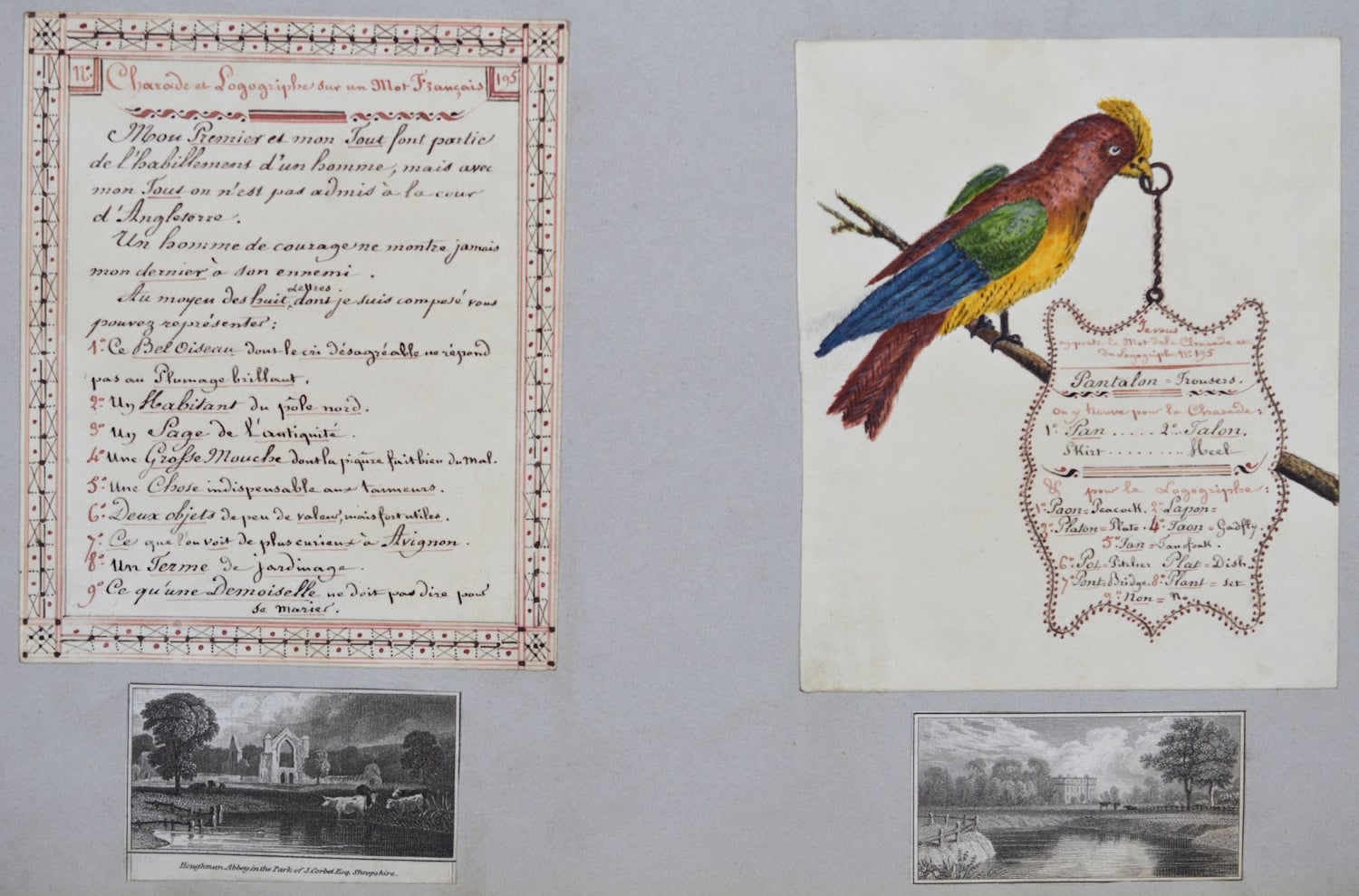
9. Logogriphes and Prints
Two finely decorated handwritten Logogriphes with two small prints, A Country House and Abbey.
10. Blank Page
Blank.
11. Ten Commandments and Charles Grey Portrait
Pen-and-ink Ten Commandments on yellow paper, with letters infilled by fine inscriptions. Accompanied by a lithographic portrait of Charles Grey (1764–1845).
12. Blank Page
Blank.
13. Small Prints
Four small prints, including a portrait.
14. Logogriphes, Animal and Fishing Prints
Two finely decorated handwritten Logogriphes with four small prints of dogs, cats and fishing scenes.
15. Blank Page
Blank.
16. Pink Rose
Watercolour, possibly after John Edwards’s A Collection of Flowers, with plates dated 1783–95.
17. Acrostic Engraving
Acrostic poem-puzzle 19th century engraving using a popular devotional poem by William Browne (1590–c.1645).
18. Blank Page
Blank.
19. Blank Page
Blank.
20. Logogriphes
Two finely decorated handwritten Logogriphes.
21. Blank Page
Blank.
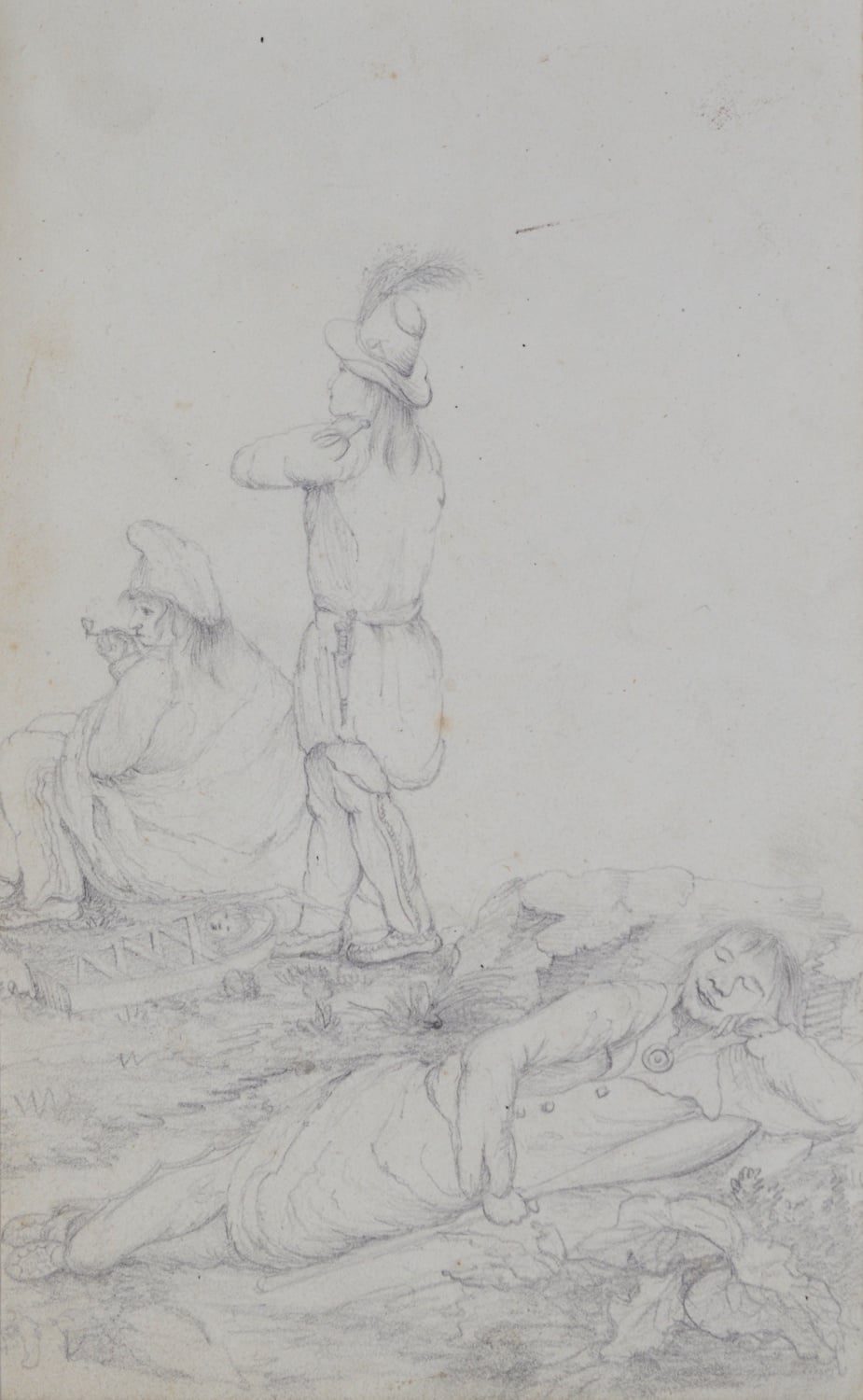
22. French-Canadian Figures and Fishmonger Scene
Recto: French-Canadian habitant figures, including one sleeping with a paddle; pencil on white wove paper. Verso: Fishmonger scene in pen and ink.
23. Blank Page
Blank.
24. Blank Page
Blank.
25. Blank Page
Blank.
26. Figures by a Fence
Verso: figures beside a fence and basket of produce. Pen and black ink on cut white wove paper, applied to the album page.
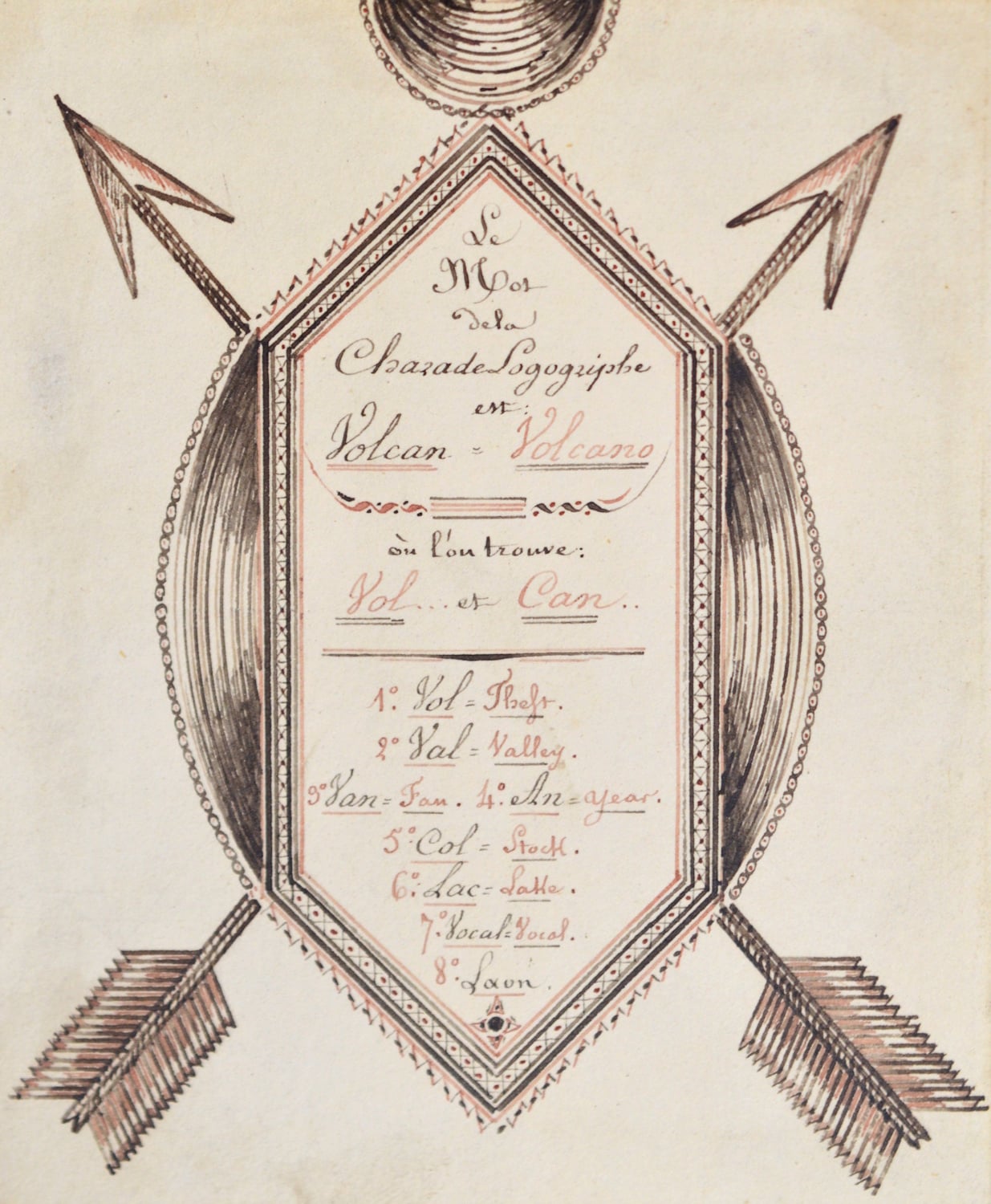
27. Emblem of France
Emblem incorporating French revolutionary symbols; pen and blue monochrome wash on white wove paper.
28. Logogriphes and Country Estates
Two finely decorated handwritten Logogriphes with four small prints of large country estates.
29. Blank Page
Blank.
30. Blank Page
Blank.
31. River St Lawrence Watercolour
Verso: watercolour over pencil on laid paper, attributed to George Heriot. Inscribed R. St Lawrence lower right. 15.7 x 23.6 cm.
32. Passionflower
Botanical study, possibly after John Edwards’s A Collection of Flowers, with plates dated 1783–95.
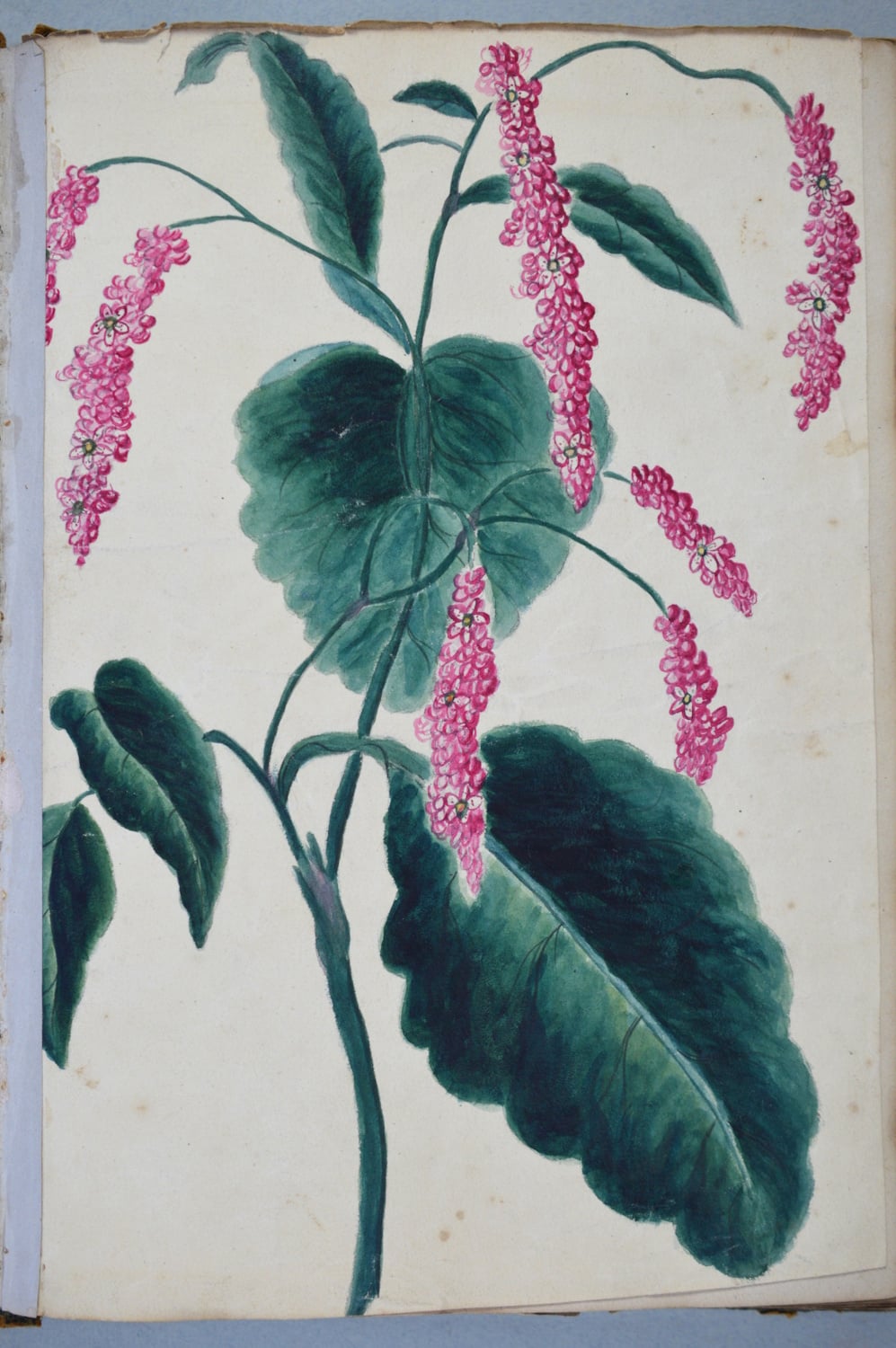
33. Persicaria sp. Knotweed
Watercolour copied from John Edwards’s A Collection of Flowers. The printed version appears as Persicaria sp. Knotweed, Folio 47.
34. Barry Edward O’Meara Label
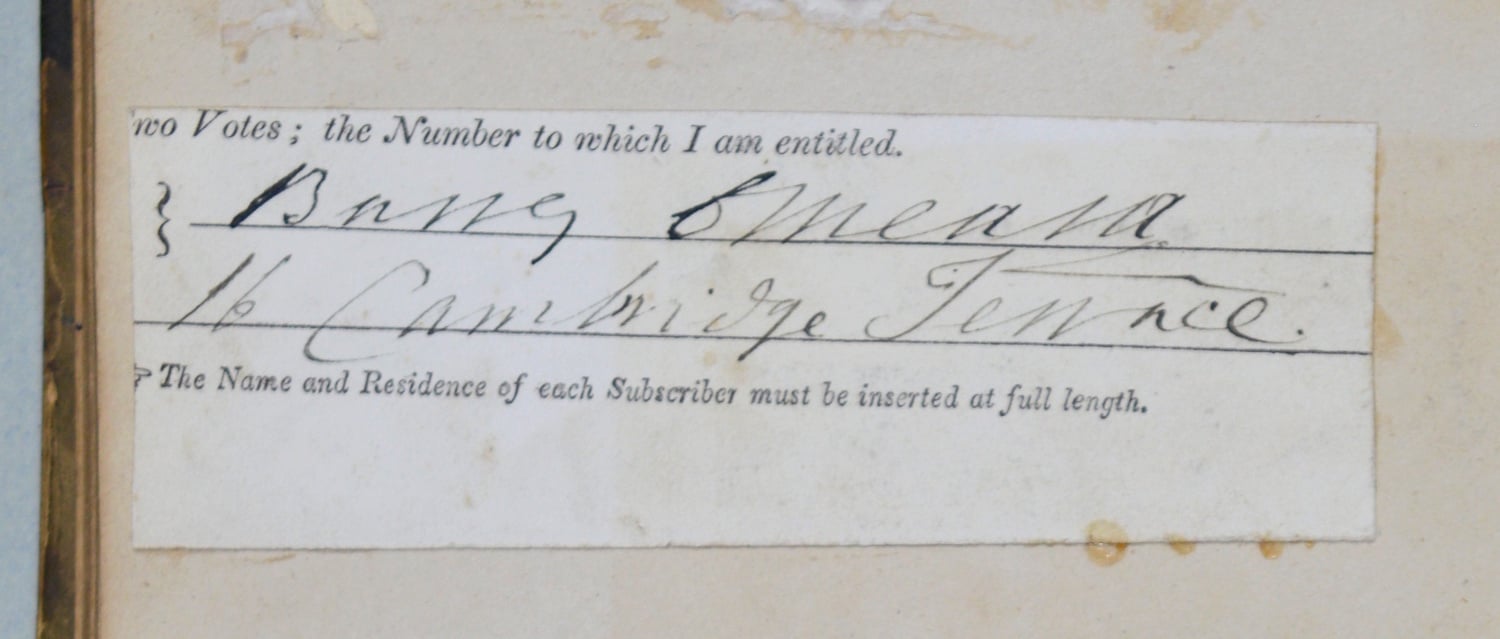
Verso: printed label signed by Dr Barry Edward O’Meara (1783–1836), Napoleon’s physician on St Helena. The label gives his London address as 16 Cambridge Terrace.
35. Engraved Prints
Five engraved prints, including a portrait of Samuel Drew.
36. Rembrandt Portrait
Wood-engraved portrait of Rembrandt captioned Painted by Himself, possibly from The Illustrated London News.
37. Blank Page
Blank.
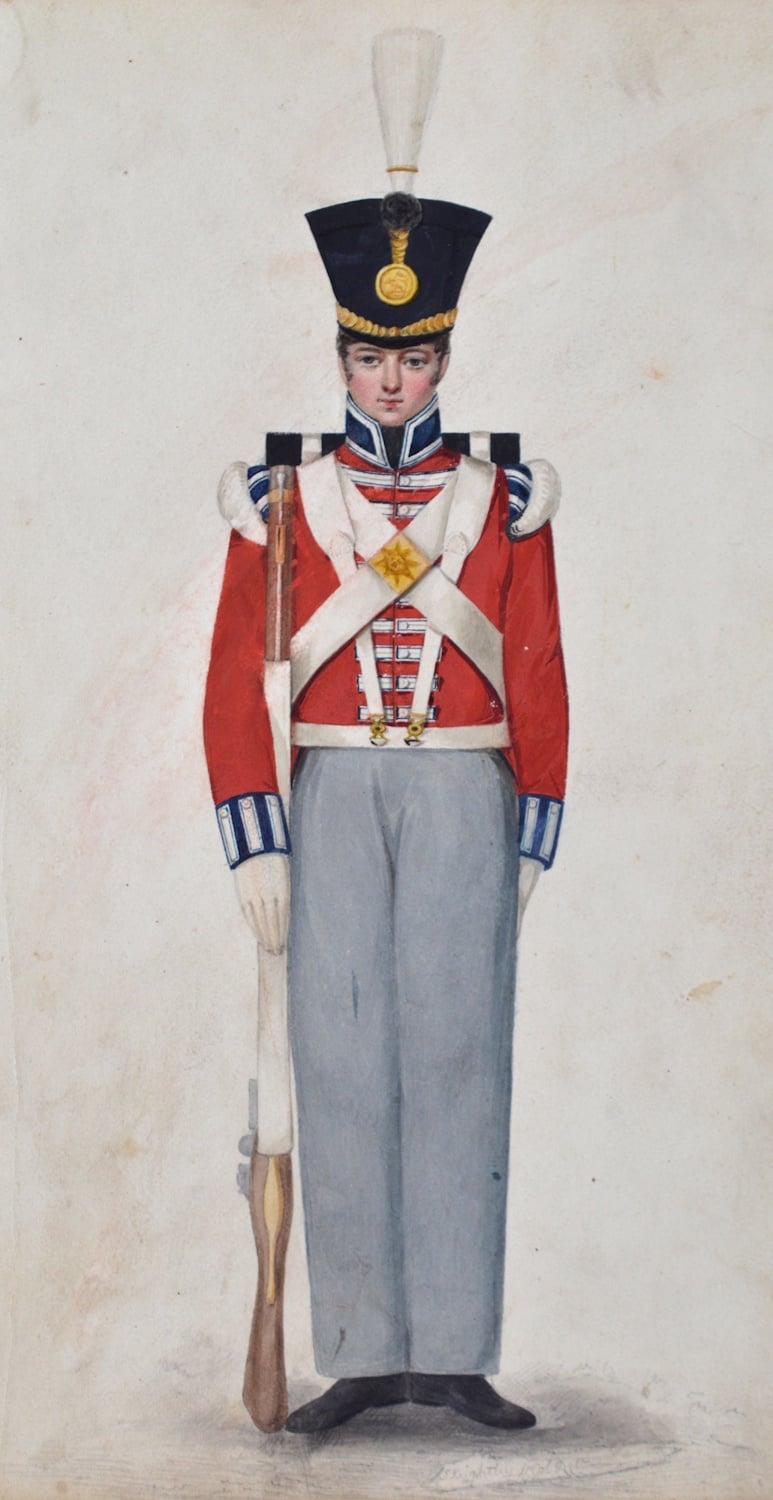
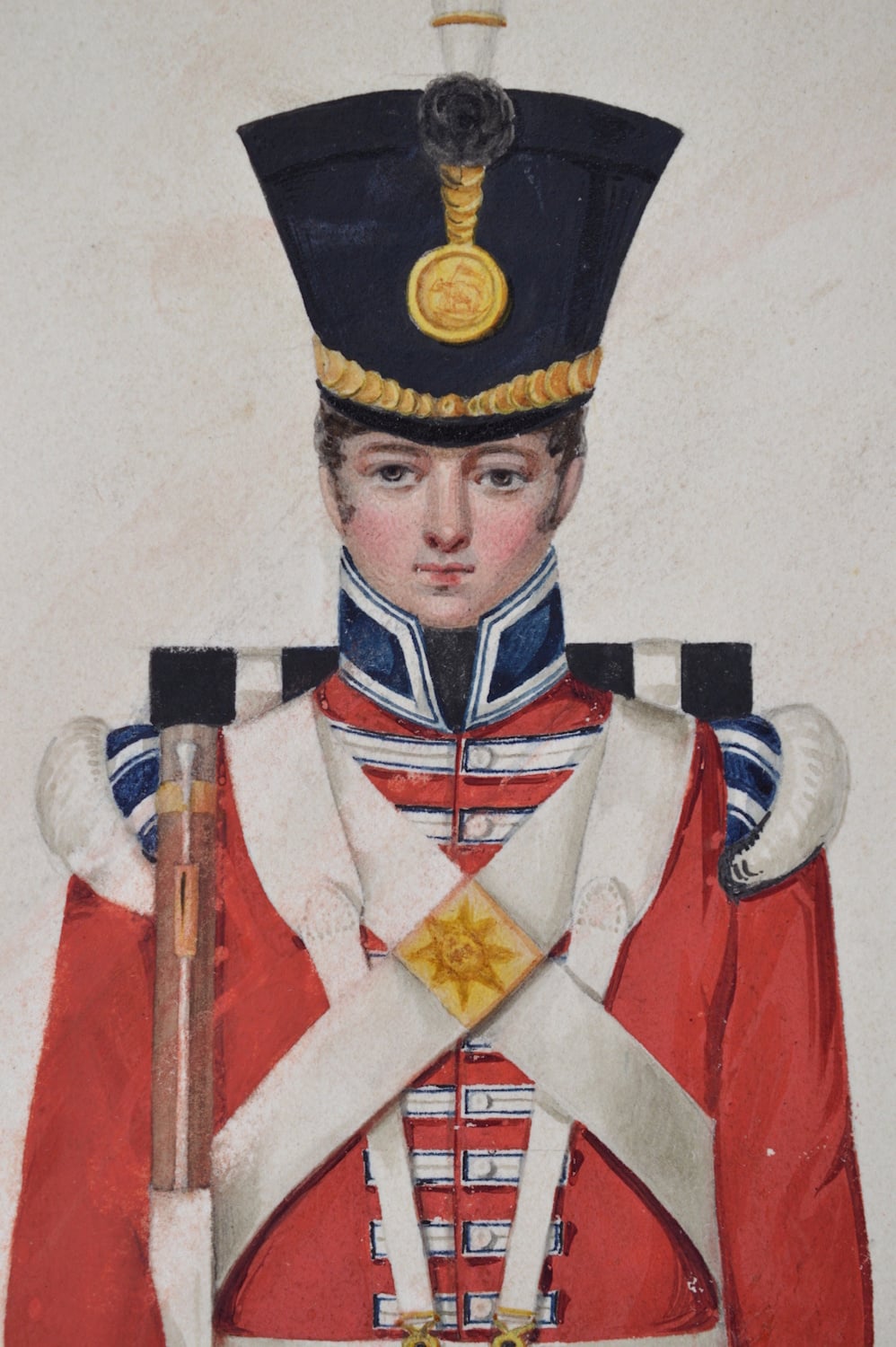
38. Young Soldier
Watercolour, pencil and bodycolour on white wove paper. Inscribed S or J Keightley Lt Col Delt. The uniform suggests a grenadier of the Queen’s Royal (West Surrey) Regiment, c.1812–16.
39. Common Wallflower and Sketches
Recto: watercolour of a common wallflower, possibly after John Edwards’s A Collection of Flowers. Verso: sketches of flowers, a butterfly and a globe.
40. Logogriphes
Two finely decorated handwritten Logogriphes.
41. Blank Page
Blank.
42. Logogriphes
Two finely decorated handwritten Logogriphes.
43. Blank Page
Blank.
44. Logogriphes
Two finely decorated handwritten Logogriphes.
45. Morning Glory
Watercolour, possibly after John Edwards’s A Collection of Flowers, with plates dated 1783–95.
46. Blank Page
Blank.
47. Logogriphes
Two finely decorated handwritten Logogriphes.
48. Blank Page
Blank.
Inverted Engraving Section
The series of biblical engravings begin from the back page rather than the front. From this end, it contains a substantial sequence of 165 hand-coloured engravings depicting biblical scenes. The series extends 23 pages beyond page 48 onto the inside page of the back cover.
The prints are based on paintings by the Old Masters, including Claude Lorrain, Nicolas Poussin, Raphael, Carracci and Holbein, among others. They appear to have been cut from inexpensive magazines or compendiums that did not survive well and thus are not widely available in collections today.
Christ Chapel Hymn
A hymn sheet was found between two of the album pages. It was printed for the opening of Christ Chapel, Mary-le-bone, and was intended to be sung on Sunday, 5th of October 1834.
Kerry Abel’s research indicates that the chapel was built in 1833/4. Its founders were Lt Col the Hon. James Stewart and Frederick Madan.
James Stewart (1783–1836) was an army officer with Canadian connections. Through his brother, Charles James Stewart (1775–1837), he also links indirectly to George Heriot: Charles James Stewart was the second Anglican Bishop of Quebec and travelled through Upper and Lower Canada as a missionary for the Society for the Propagation of the Gospel from 1807, exactly the same time in which Heriot was active there.