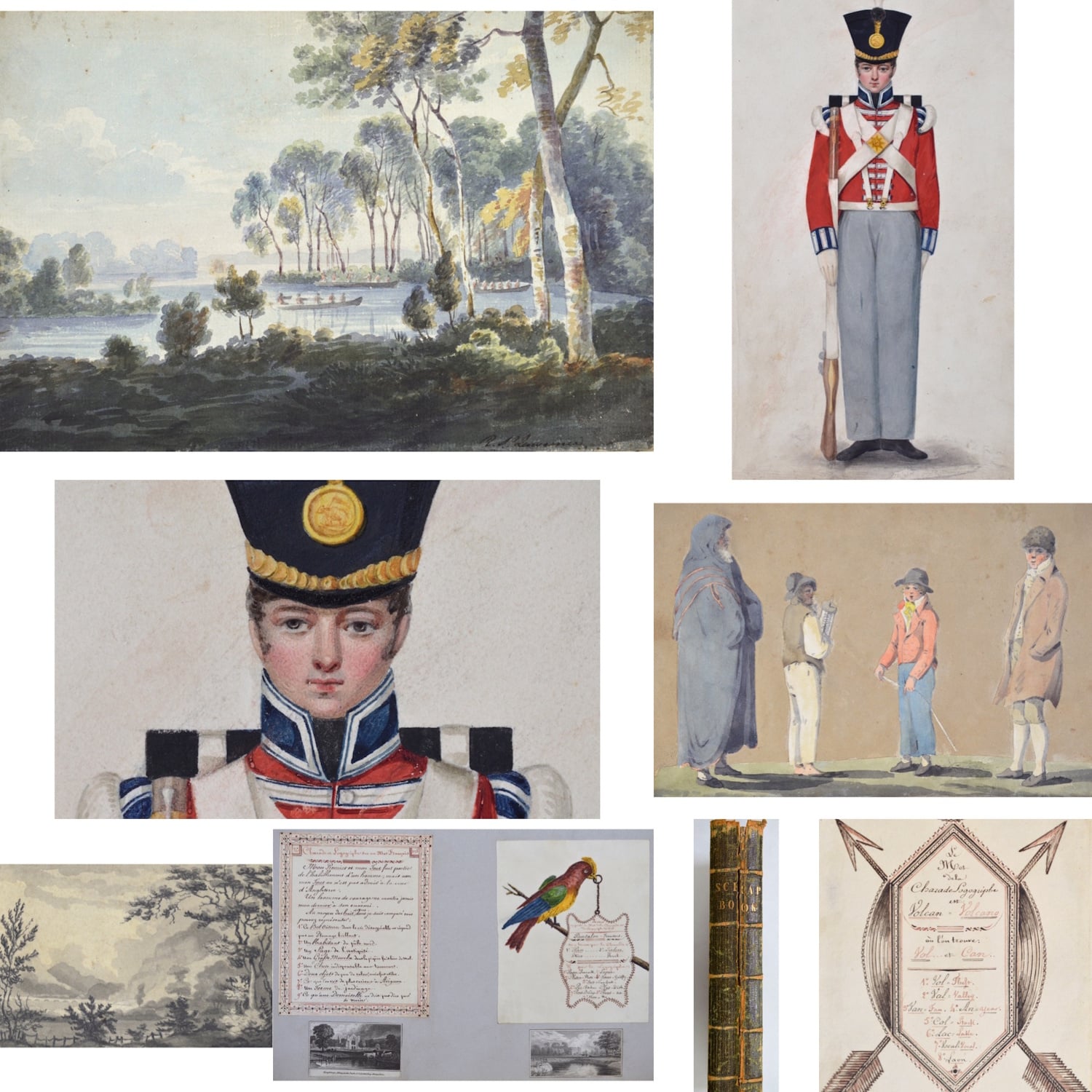
Heriot, George (1759-1839)
George Heriot (1759–22 July 1839) was a Scots-Canadian civil servant, author and artist, best known as an important figure in early Canadian art.
Born in Haddington, Scotland, in 1759, Heriot was the eldest child of John Heriot, the town’s sheriff clerk, and his wife Marjory. The family belonged to the long-established Heriots of Trabroun, whose best-known member was the seventeenth-century goldsmith and philanthropist George Heriot. He was educated at Duns, Coldstream Grammar School and Edinburgh Royal High School, where he received a classical education from 1769 to 1774. He then remained in Edinburgh, studying art with the encouragement of Sir James Grant.
In 1777 Heriot went to London, apparently to pursue an artistic career, but instead sailed to the West Indies. The reason for the change is unclear, though his father’s business failed that year and his younger brother John left university to join the Army. Heriot wrote and sketched extensively in the Caribbean and, after returning to London in 1781, published A Descriptive Poem, written in the West Indies. He later enrolled at the Royal Military Academy, Woolwich, where Paul Sandby taught him landscape drawing and painting, then considered essential to military education.
By 1783 Heriot had left the academy but remained at Woolwich as a civilian Army clerk. In 1792 he was posted to Quebec as a clerk in the ordnance office.
His arrival in Canada began a 25-year association with the colony. Little is known about his first years there, although surviving sketches show that he travelled around Quebec and Montreal, and he published one sketch in the winter of 1792. In 1796 he returned to Britain, travelling along the south coast and in Wales before spending several months at the University of Edinburgh. After preparing paintings for exhibition at the Royal Academy, he returned to Canada.
After returning to Quebec, Heriot was appointed assistant storekeeper general, a senior post he may have obtained through the influence of his younger brother, the journalist John Heriot. He held this role alongside his existing position and drew both salaries until 1799, when the commander-in-chief discovered the arrangement and removed him from the newer post. Through family connections, Heriot had also met William Pitt in London, whose influence helped secure his appointment in October 1799 as deputy postmaster general for British North America. He replaced Hugh Finlay, who had lost government support after serious financial difficulties. Heriot later failed to gain Finlay’s former seat on the Legislative Council of Lower Canada, a setback that permanently damaged his relationship with Lieutenant Governor Robert Shore Milnes.
Heriot approached the postal service role energetically, seeking to extend faster and more reliable mail beyond the Quebec-to-Montreal route and into newly settled areas of Upper Canada. He soon faced administrative and financial obstacles: new services had to be self-supporting, and profits could not be reinvested locally. With support from local authorities, including Peter Hunter, lieutenant-governor of Upper Canada, he nevertheless achieved a limited but noticeable improvement in western postal services by 1805.
Heriot later became increasingly at odds with the administration and resigned in 1816. He returned to Britain, where he lived in retirement.
Showing the single result