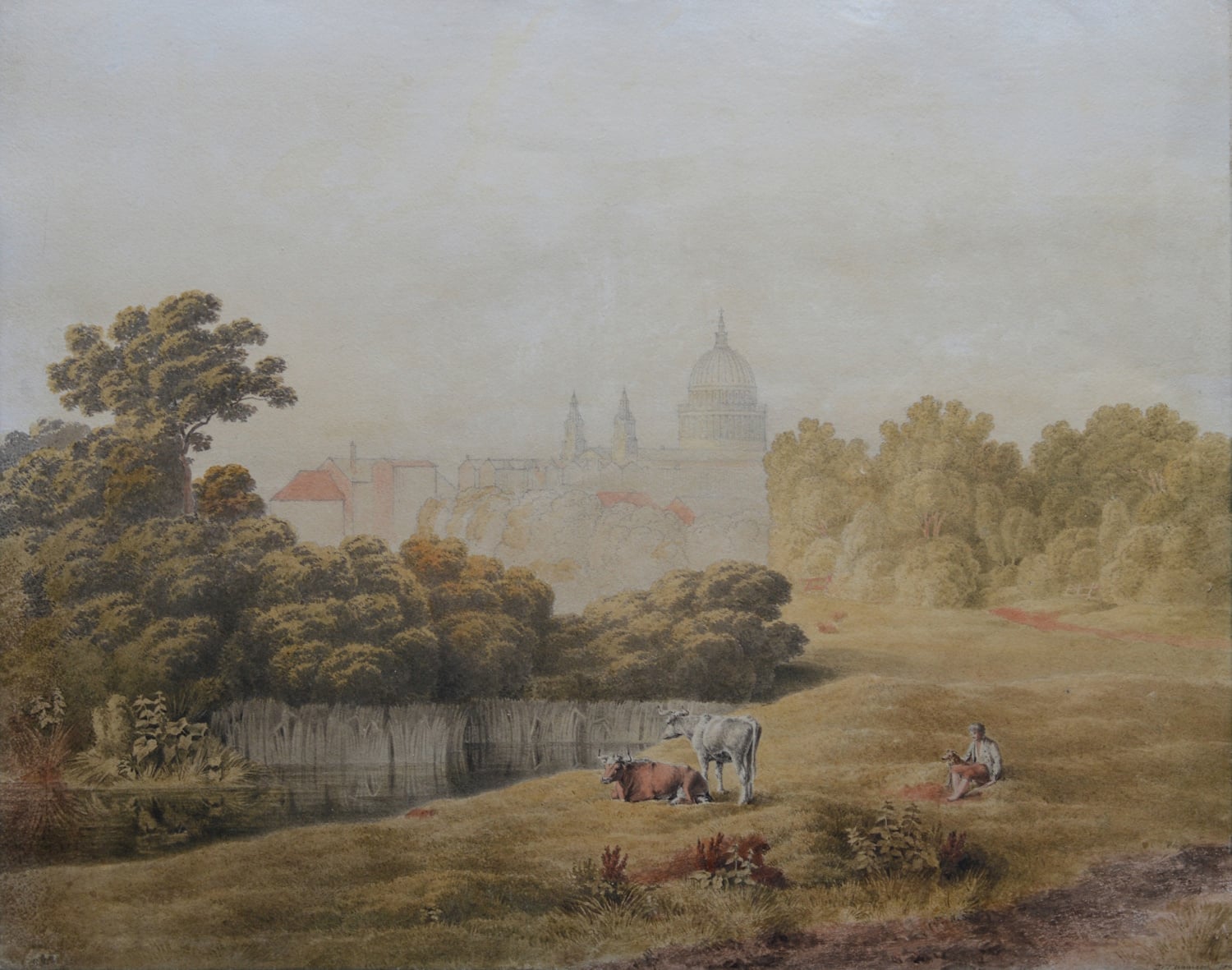
Thomson, David (born aft. 1758 - d. 1815)
David Thomson (d.1815) was by profession an artist and an amateur musician., he exhibited landscapes at the RA 1, BI 1, and 3 others from 1807 to 1813. Records show that in 1807 he was sharing accommodation at 122, Piccadilly, with the miniature painter, William John Thomson R.S.A. (1771-1845). Both artists exhibited at the R.A. in the same year. His brother George Thomson (1757-1851) was a music collector and publisher. David provided illustrations and songs for his brother George’s collections of national airs. With Muzio Clementi of London he published his own collection, ‘The melodies of different nations’, and a collection of Mozart songs with his own lyrics. In 1806 he made a tour to Wales to create illustrations for George’s collection of Welsh airs, and by 1813 he was based in London. Joanna Baillie wrote fondly of him in a letter to George Thomson of 17 June 1815 (BL, Add. MS 35264, fols. 218–20), the year of David’s death. She spoke of ‘his worth and his various talents.’ Keith Thomson, a half-brother (d.1855), was a leading teacher of music at Inverness. Paton Thomson, the engraver (cf. Redgrave), was probably a relative.
To understand a little more about David Thomson it would be helpful to read about his brother George.
George Thomson (1757-1851) was a Scottish music collector and publisher and a friend of Robert Burns, he was born on 4 March 1757 at Limekilns, Dunfermline, Fife, the son of Robert Thomson, schoolmaster, and his first wife, Anne Stirling. Little is known of his parents, Though Robert remarried following Anne Stirling’s death in the late 1760s or early 1770s. By this time the family had moved north to Banff, where Robert taught English language in the council school. George received his early education there (1762-72) before moving to Edinburgh in 1774.
After working in a legal office, in 1780 Thomson was appointed junior clerk to the board of trustees for manufactures in Scotland. He states in an autobiographical letter that this was made possible only by the ‘influence of Mr John Home, author of Douglas, with one of the members of the honourable Board of Trustees’ (Wilson, 38–42). Soon afterwards he became senior clerk to the board, and he retained this post until his retirement in 1839. On 11 December 1781 he married Katharine Miller (1764-1841); they had two sons and six daughters. One daughter, Georgina, married the music critic George Hogarth, and their daughter Catherine became the wife of Charles Dickens.
Thomson was an amateur violinist and singer, and through connections with the board he gained access to the select concerts of the Edinburgh Musical Society. There he heard the best of contemporary European composers and performers. The castrato Ferdinando Tenducci made a particularly strong impact with his renditions of traditional Scots songs. Thomson was so inspired that he decided to collect, commission, and publish ‘all our best melodies and songs’ with ‘accompaniments to them worthy of their merit’ (Hadden, 20). With the financial help of Robert Arbuthnot, secretary to the board of trustees, Thomson launched the first of his publications, A Select Collection of Original Scottish Airs (1793). The title-page and preface explained his intentions: he provided ‘Introductory & Concluding Symphonies & Accompaniments for the Piano Forte & Violin’ (often performed with cello and later with flute too); he also presented ‘Select & Characteristic Verses by the most admired Scottish Poets adapted to Each Air’, some of which were ‘entirely new’, and provided ‘Suitable English verses in addition to such of the songs that are written in the Scottish Dialect’. Over the next fifty years he commissioned Pleyel, Kozeluch, Haydn, Beethoven, Hummel, and Weber to provide musical arrangements, as well as British musicians George Farquhar Graham, Henry Bishop, and Thomson’s son-in-law Hogarth. Thomson was an early champion of Beethoven’s works in Britain, in his capacity as one of the first directors of the Edinburgh musical festival (from 1815). In addition to his selection of lyrics from other publications, he commissioned and corresponded with around forty writers, including Robert Burns, Walter Scott, Alexander Boswell (brother of the more famous James), James Hogg, Joanna Baillie, Amelia Opie, Anne Grant, William Smyth, and Lord Byron.
Thomson conducted his publishing business from home and used banking and diplomatic channels to transport his correspondence and manuscripts to and from Europe. He appeared on the titlepages as the proprietor, never as the publisher. His volumes were all issued by John and Thomas Preston of London. They included drawings by R. T. Stothard, David Wilkie, David Allan, Alexander Nasmyth, and Thomson’s brother David. Thomson continued publishing and reissuing volumes until just a few years before his death. They finally numbered six volumes of Scottish airs (1793-1846), three of Welsh airs (1809–17), and two of Irish airs (1814–16). He also issued a six-volume royal octavo edition between 1822 and 1825, which was later reissued. The bibliography of his collections is complex in the extreme, and the survey by Cecil Hopkinson and C. B. Oldman (1940) is invaluable.
Portraits reveal a serious and studious man, with spectacles and rounded features. Thomson masterminded many of the trustees’ events and was well liked, and a testimonial dinner was given in his honour in Edinburgh in 1846. He remains best known as the Scottish music publisher associated with famous composers and with Robert Burns. He is unpopular with Burns readers and scholars, primarily for his adaptation and alteration of many of Burn’s songs, and for his pompous obituary of the poet (London Chronicle, July 1796). Cedric Thorpe Davie’s opinion that Thomson’s ‘huge pretentious volumes’ were a ‘sad memorial to misplaced enthusiasm and ignorant amateurishness’ (Davie, 16) is typical of twentieth-century musicologists. Thomson died at his home, 1 Vanburgh Place, Leith, Edinburgh, on 18 February 1851, and was buried beside his wife at Kensal Green cemetery, Middlesex.
Showing the single result