Description
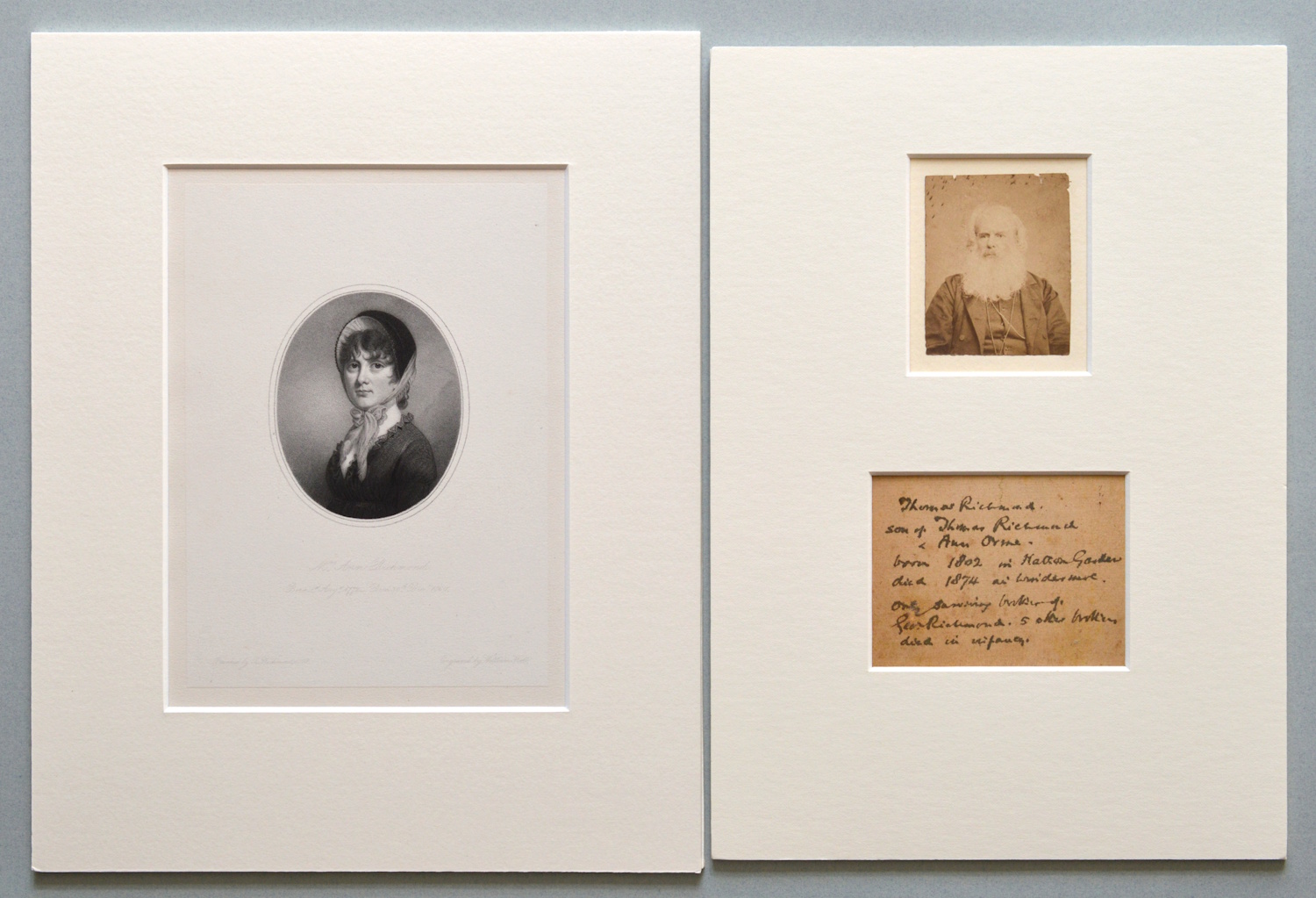
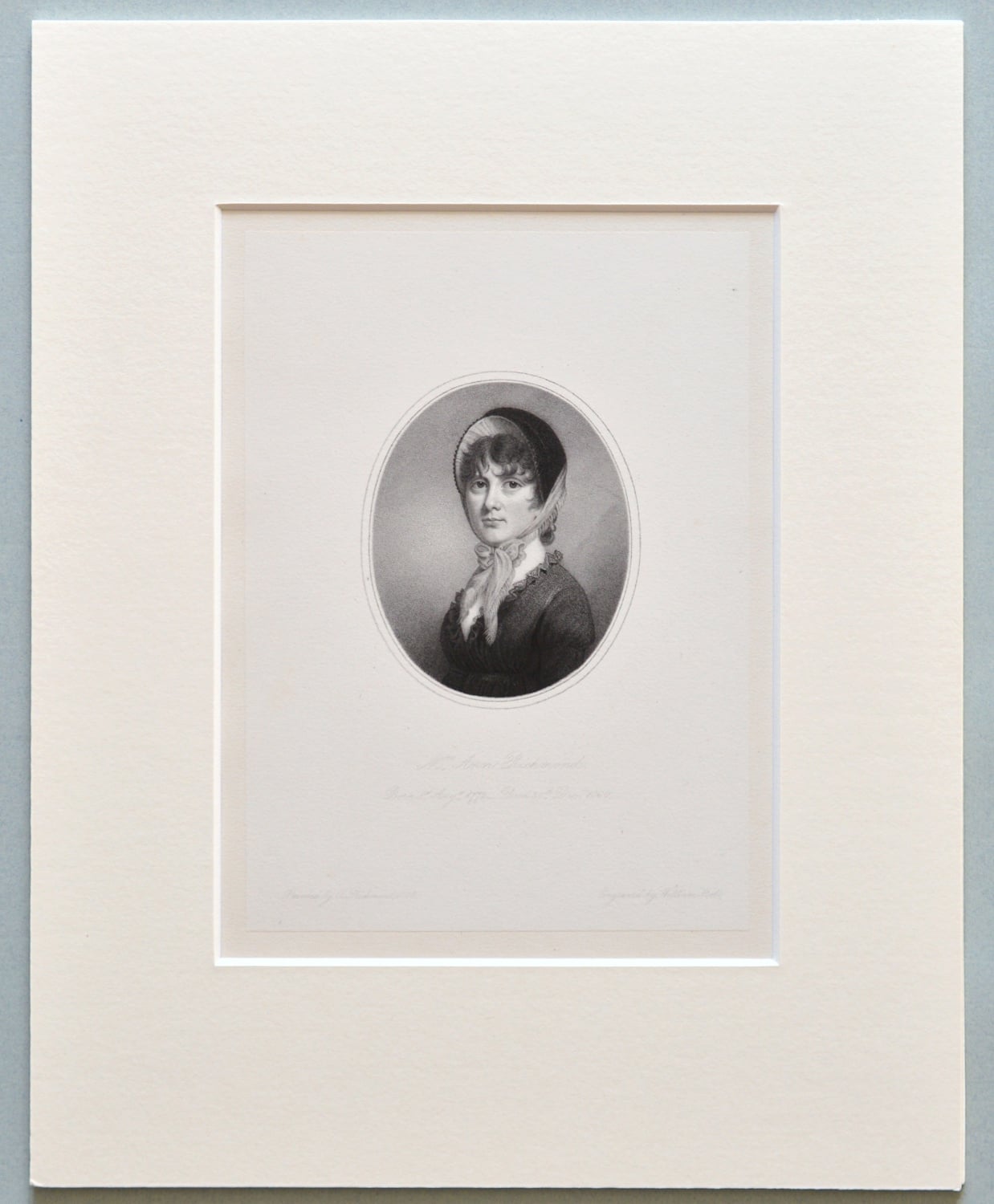
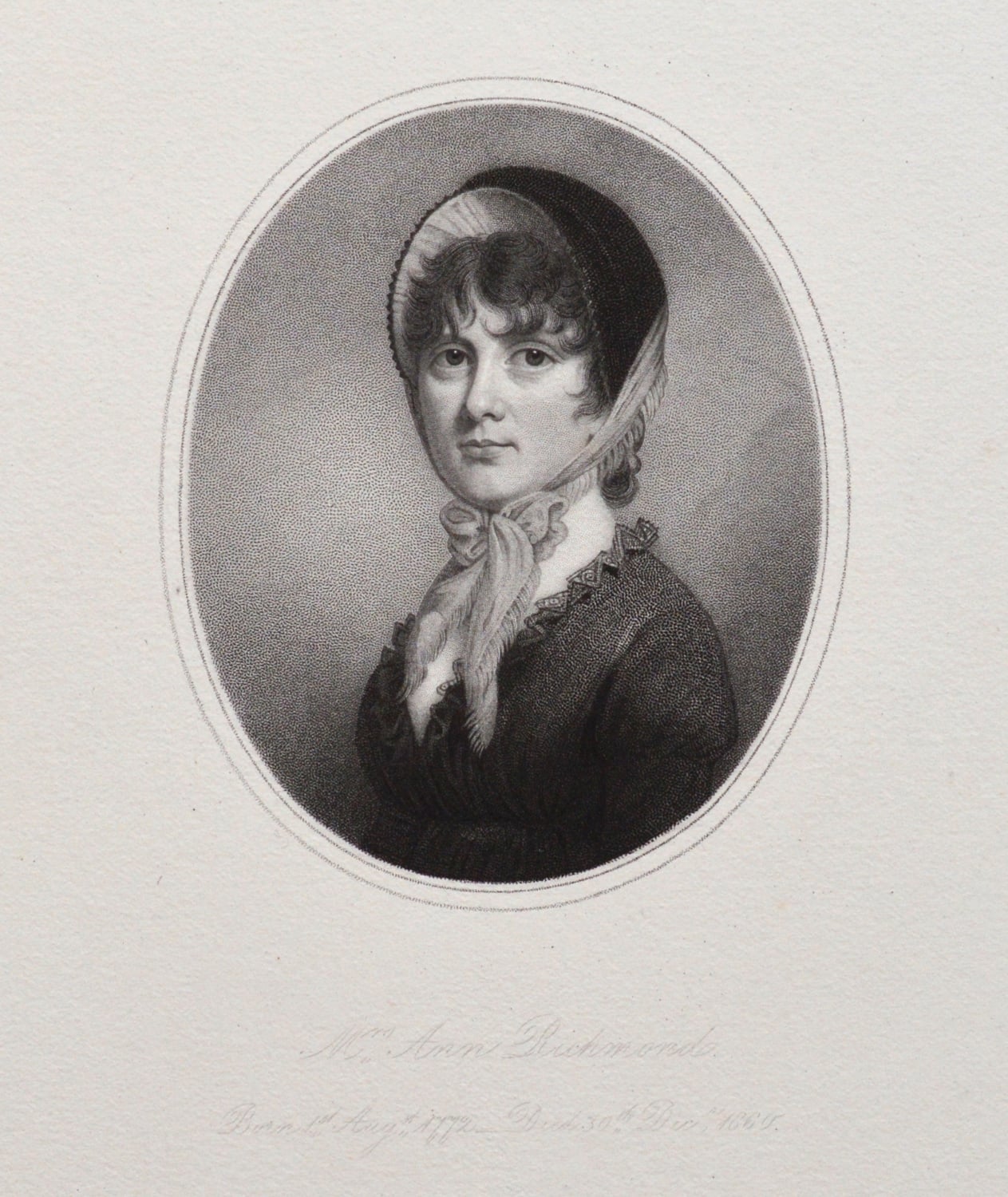
Anne Richmond
Anne was known far and wide for her beauty. Her father kept an Inn at Kew Green and her mother died when she was young.
As an old lady she remembered the burning of Newgate during the Gordon riots and was taken to see Lord Gordon in prison. After her marriage she often saw Lord Nelson at Portsmouth, in which town her husband practised his art as a miniature painter. She also knew Shelley, who had lodged in the same house with her in Half Moon Street, Piccadilly.
A year before Anne died she gave a true and first hand account of a ghost story to her then, 16 year old grandchild, W B Richmond. After her mothers death her father immediately left the city and moved to Chelsea. At the back of their new house was a large and neglected garden which was used by their Newfoundland dog, and the children for games. One day while the children were playing “catch who catch can,” Anne’s brother, who was leading, came to some steps descending into a kind of hole; Anne followed but at the bottom of the steps there stood their mother, saying nothing but standing there in the attitude of pushing them back. Shocked by their dead mothers appearance they retreated immediately. When they told their father what had happened he sent them to bed for what he considered to be a monstrous lie. A few days after, the Newfoundland dog went missing; a search for him was made in the garden, and it was found that he had made his way down those same steps, had trodden upon some rotten planks overgrown with weeds, fallen into a covered well, and drowned.
Anne died in John Giles’ house where she had lived for some years.
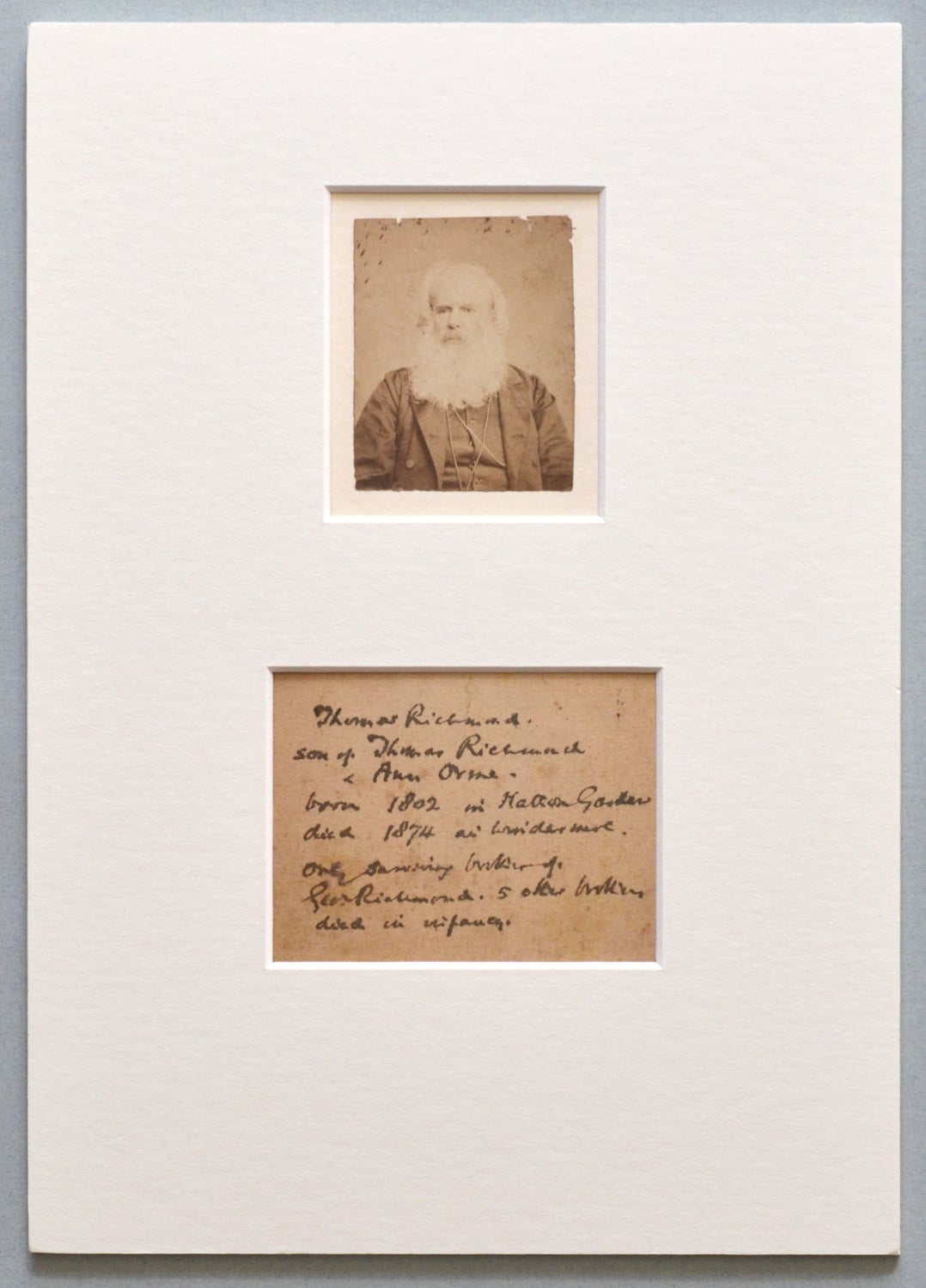
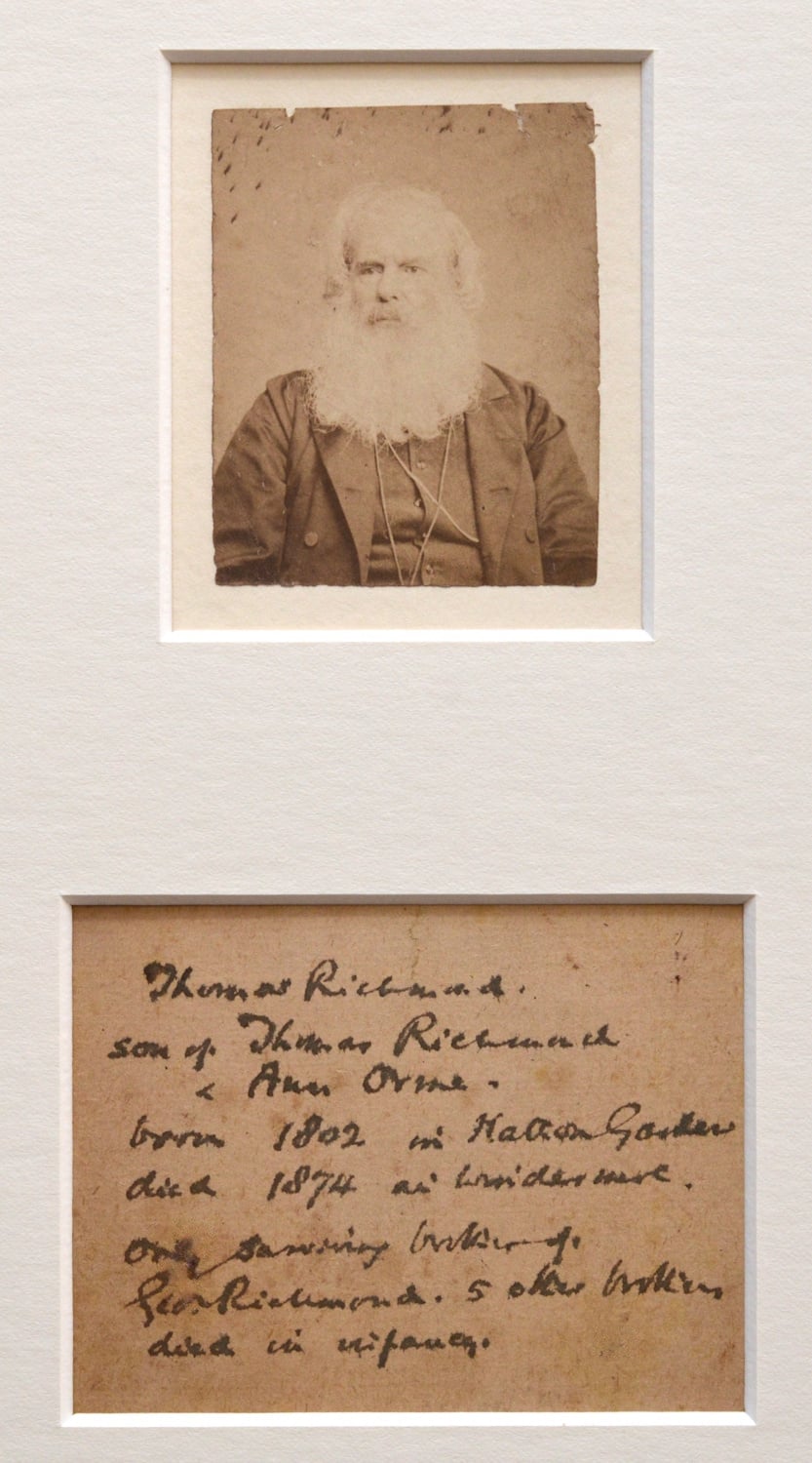
Thomas (Tom) Richmond Jnr.
Thomas Richmond was a portrait painter, known for his idealised pictures in the so-called Keepsake style. His father Thomas Richmond (1771–1837), was a miniature painter, and his brother George Richmond RA (1809-1896) was a celebrated portrait painter.
Richmond initially practiced in Sheffield, and later moved to London. His main clientele was among the hunting fraternity. Between 1833 and 1860 he exhibited fifty one portraits in London. He exhibited forty-five portraits at the Royal Academy and six at the Suffolk Street gallery. Richmond’s paintings are close in style to his father’s work, but distinguished by the characteristic use of dark stippling in the background.
Richmond and his brother George had met Ruskin during his trip to Rome in 1840-1. He accompanied him on his visits to galleries. John Ruskin’s father commissioned Richmond to paint his daughter-in-law Effie Gray, Effie wrote of the finished work to her mother: ‘…it is the most lovely piece of oil painting but much prettier than me. I look like a graceful Doll but John and his father are delighted with it’. Ruskin’s father was not as delighted with the portrait of Effie as she believed. He wrote to his son that Thomas was inferior as an artist to his brother: “Tom I regret to say cannot hold a candle to George – It is second rate or lower”.
Tom Richmond died in 1874 at Windermere, where he had purchased an estate but was buried in Brompton Cemetery, London.
Brand
Richmond, George (1809-1896)
George Richmond was born to Thomas and Ann Richmond on the 28th March 1809. A natural facility for draftsmanship revealed itself at an early age. He is one of the youngest students ever to have been admitted to the Royal Academy schools. The Academy permanent collection holds drawings made by Richmond while studying in the school of the Antique.
In 1825 he met William Blake and, along with Samuel Palmer and fellow student Edward Calvert, became devoted to the aging artist. The young men would come to refer to themselves as the Ancients. The group followed the artistic principles of Blake and worked to ideals inspired by renaissance painters, particularly Michelangelo and Dürer. The party retired to Palmer's country home at Shoreham during the late 1820's, residing together and developing their aesthetic theory. They lived simply and worked hard.
In 1831 Richmond married Julia Tatham, daughter of Charles Heathcote Tatham. The marriage was immediately central to his life and they were to have thirteen children, ten of whom survived into adulthood. The necessities resulting from such a large family compelled Richmond to change direction artistically. It was impossible to follow the eclectic road taken by the Ancients and feed all the hungry mouths. The ramifications of this situation remained with Richmond for the rest of his professional life.
Richmond was an extremely religious young man. His beliefs chimed with the growth of evangelical devotion and he found a fellow communion among the members of the "Clapham Sect". Sir Robert Inglis was an early supporter of Richmond, and benefactor to the children of Henry Thornton, one of the founders of the Clapham group. It was through Inglis that Richmond received an important commission in 1832. Richmond landed a coup in painting the great emancipator, William Wilberforce. The positive public response to this portrait established Richmond, almost overnight, with a successful portrait practice.
From the early 1830's portrait painting became Richmond's primary source of income. By the late 1830's his financial security was such that he could afford to travel to Italy with his young family and that of Samuel Palmer. Richmond's experiences in Italy are recorded in his journals, which comprise part of this archive.
Richmond rarely left Britain after a second journey to Rome in 1840-1841. He worked hard over the next forty years, painting around 2500 of the most prominent figures of Victorian society. His learning in art practice and art history led him to be considered one of the country's foremost experts on painting restoration. This discipline took on more importance for him as his energies for portrait work flagged in the 1870's and 1880's. His residence, Porch House, in Potterne, Wiltshire, was regarded as a model of sensitive architectural restoration. He declined the position of director of the National Gallery at least once, citing ill health. Health was a perennial concern of this long-lived hypochondriac.
Julia Richmond died in 1881 and from this point Richmond entered the last, relatively secluded phase of his life. His closeness to the survivors of the Thornton clan is particularly evident towards the close of his life. Richmond died in 19th March 1896; having seen his son William Blake Richmond elected a Royal Academician the year before.
Richmond, Thomas (1771-1837)
Was the son of Thomas Richmond, originally of Bawtry, and of an old Yorkshire family. His father was 'groom of the stables' to the Duke of Gloucester, and afterwards the proprietor of the Coach and Horses at Kew, where the artist was born in 1771. His mother, Ann Bone, was a cousin of George Engleheart, 'miniature-painter to the king.'
Thomas became Engleheart's pupil, and was employed by the royal family in copying miniatures by his master and Richard Cosway. He also copied in miniature size many of the portraits by Sir Joshua Reynolds in the royal collection. His original and unsigned miniatures are numerous. Some are on ivory, others are on paper, and in many cases full or half length, with the head in colours and the rest in pencil. Though the pose of some of his figures is in the stiff manner usual at the time, the
portraits are lifelike, and the drawing and expression excellent.
In later years Richmond lived in the centre of fashion, 42 Half-Moon Street, Mayfair. From 1795 to 1825 he exhibited forty-six miniatures at the Royal Academy. One of his miniatures, a portrait of his wife (Ann Oram), painted in 1808, was engraved by William Holl, jun.
His eldest son, also named Thomas Richmond, was born in 1802. His younger son, George Richmond, inherited many of his works. Both of his children also became noted artists.
He died in 1837, and was buried in Paddington churchyard.